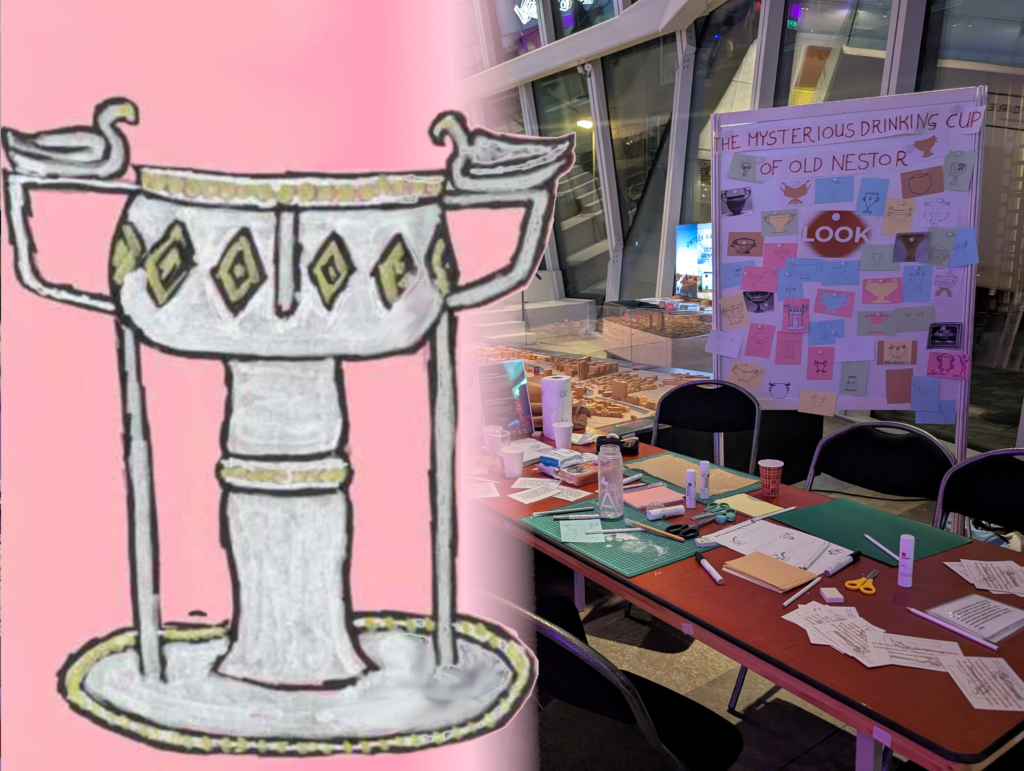
The Eureka! Science Festival took place a few weeks ago, on September 25, filling the Forum Groningen with scientists from the Rijksuniversiteit Groningen and curious visitors of all age groups. FACERE was part of the festival with a lecture by Hylke de Boer and a crafting workshop by Friederike Brunzema.
At 20:00 Hylke gave a short public lecture (in Dutch) on the relationship between humans and nature in Pliny’s Natural History, titled ‘Zou Plinius zich vastlijmen aan de A12?’ He concluded that Pliny would not in fact associate himself with modern climate activism since, although he has great respect for the earth and its gifts to humanity, he sees nature partially as a resource to be unlocked by the Roman empire. Hylke’s talk struck up a lively conversation with the audience about, among other things, the popularity of Pliny’s work in his and later times and conceptions of nature and sustainability in antiquity. Immediately after, Hylke did a short recap of his talk in a brief radio interview with OOG op Wetenschap, which can be found below. A longer interview with OOG op Wetenschap on Hylke’s research will follow soon.
In addition to Hylke’s very successful sprint during the prime time of the festival, the FACERE Team managed a workshop marathon, from 11 in the morning to midnight, sharing the mystery of Nestor’s cup with the visitors of the festival. Students from Groningen stopped by at our cupmaker’s corner in the afternoon program and learned about the cup as a literary object and the pursuits of ancient scholars. In just 10 min. each, they gave us great questions to think about, and lovely drawings of their Nestor’s cup. For some, this might have been the first contact with the world of the Iliad.
Later in the night, with the start of the Eureka! Festival, visitors had the opportunity to not only make a drawing, but also bring their vision of the cup to reality using clay. Looking back on this evening, we had many talented artists coming up with unexpected solutions to some burning problems of ancient scholarship: How can we imagine a cup with four handles and two bases? How many doves are on this cup, or are they really doves?
We left the Forum with the most creative answers, and just one more substantial question: Did the Greeks bring the cup with them when they hid in the Trojan horse?
A broader reflection of the event with a snippet of Friederike’s experience and how different researchers approached the preparation and festival can be found here:
https://www.rug.nl/aletta/nieuws/throwback-article-eureka