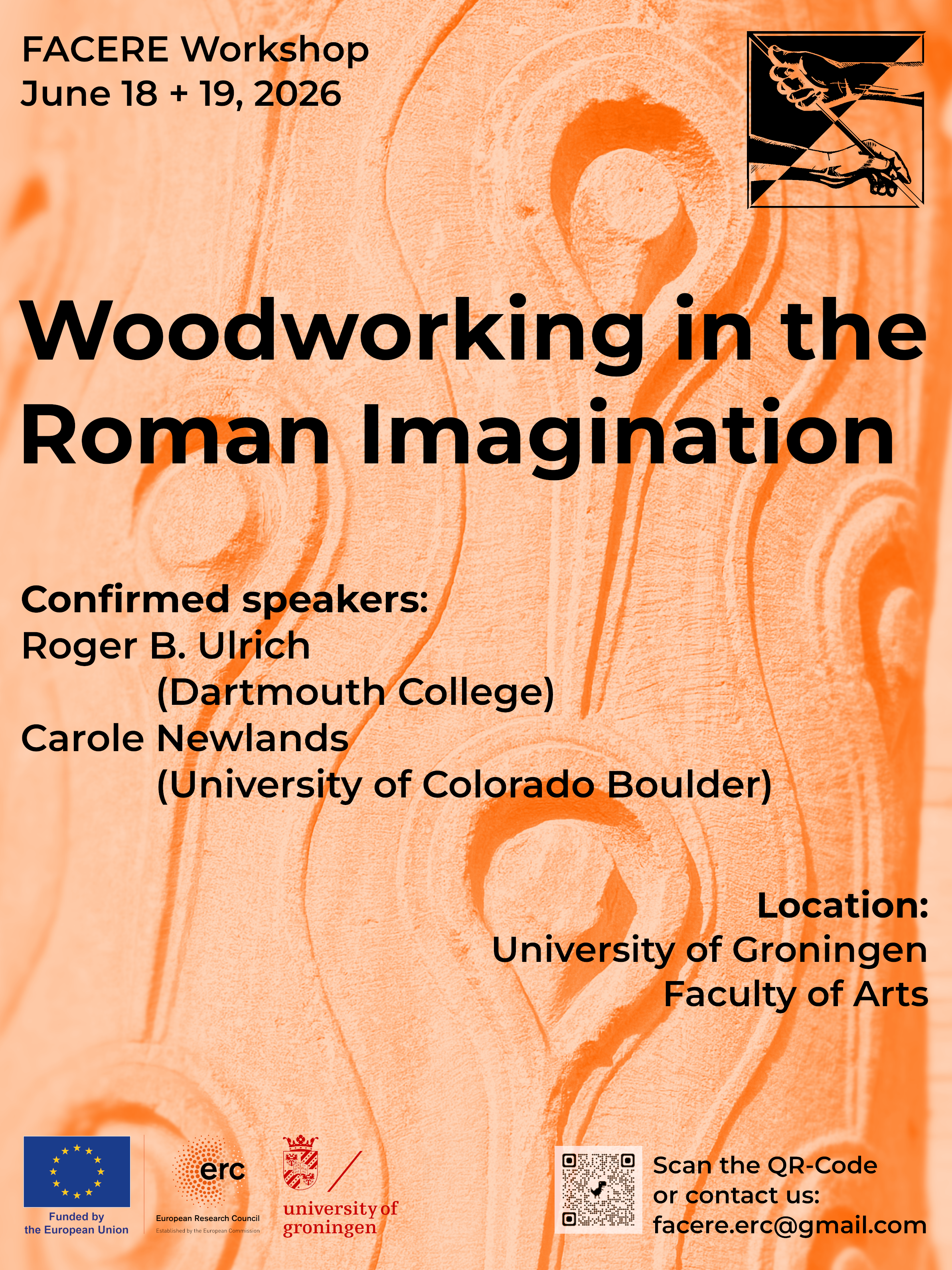
On June 18 and 19 FACERE is organizing the workshop “Woodworking in the Roman imagination” in Groningen.
Wood was an omnipresent resource in the Roman world, ingrained in every human’s life, from those living in the most precarious circumstances to the richest and most powerful in the empire. Wood has been extensively studied in terms of its economic and logistical importance, contributing major advances in our understanding of the technology and organisation of Roman woodworking. This workshop aims to bring such insights into dialogue with Roman discourses surrounding woodworking in literature, epigraphy and visual culture from the Roman Republic to Late Antiquity. In light of recent reconsiderations of trees beyond strict resources and a rising interest in the narration of craft processes in Greco-Roman antiquity, we aim to explore Roman conceptions of living and laboring with wood, relying on, yet transcending, technical questions of how wood was worked in Roman antiquity.
Individual papers will approach depictions of woodworking and human-wood interaction in artistic, literary and epigraphic media. Together, we seek to trace Roman ideas about human-wood entanglements from arboriculture and tree-felling to the production of ships, buildings, tools and other wooden artifacts. This workshop will contribute to a multi-faceted understanding of the many meanings of woodworking in ancient Rome. It forms part of the ERC-FACERE project which investigates discourses of making in the Roman world. We look forward to welcoming Roger B. Ulrich and Carole Newlands as our keynote speakers. We are also happy to welcome our other speakers, including Andrew Fox, Marco Formisano, Myrto Malouta, Frances Foster, Matthew Westermayer, Daniel Falkembach Ribeiro, Marietta Horster, Maxime Duval, and Giulia Dovico. If you are interested in attending our workshop, feel free to send an email to FACERE.ERC@gmail.com.